|
|
 |
Probability Question - Page 4 |
 |
1
 |
brambolius Netherlands. Sep 11 2008 03:12. Posts 1708 | | |
| | On September 10 2008 18:49 CrownRoyal wrote:
i figured it out
RAKE WINS! |
im with crown lol |
| |
|
| 1
 |
Repusz Hungary. Sep 11 2008 05:00. Posts 1033 | | |
My English isn't refined for this stuff but if you have maths background hopefully you can dechiper what I am trying to type and verofy / fix it correctly.
The outcomes follow binomial spread (or whatever it translates to in English  ) since each deal is independant with a predefined probability for both winning / losing. In order to bust you have to lose 1000 more than winning, aka in n attempts you win n/2-500 and lose n/2+500. ) since each deal is independant with a predefined probability for both winning / losing. In order to bust you have to lose 1000 more than winning, aka in n attempts you win n/2-500 and lose n/2+500.
The probability in "n" attempts is ( n! / ((n/2-500)!) * (n/2+500)!) ) * (0.51^(n/2-500)) * (0.49^(n/2+500))
I hope I typed in all neccessary ( ). I don't have a scanner atm to make it simplier.
|
|
| | Last edit: 11/09/2008 05:06 |
|
| 4
 |
[vital]Myth  United States. Sep 11 2008 06:44. Posts 12159 United States. Sep 11 2008 06:44. Posts 12159 | | |
this
| | On September 10 2008 20:56 killThemDonks wrote:
Show nested quote +
On September 10 2008 20:49 Pacifist wrote:
All you people who are so confident it's 100% and laughing at others trying to do math have no idea how hard you are owning yourselves. |
this is simply a random walk question that can be solved using markov chains
to solve it one must assess the probability of going bust from different states. define your state to be the amount of money you have remaining (for simplicity assume you have 1000$ and each round you wager 1$), so:
state 0: BUST
state 1: 1$ remaining
state 2: 2$ remaining
....etc
So in this case we start at state 1000 and each round (independently) we have probability (pr) of winning as 0.51 and losing as 0.49.
The question really is, on average, which state will we be in, given that there is no limit on how much we can win.
i think the answer is non trivial and...i just lost all motivation to do this now....maybe later...but if you are interested in working it out check "gambler's ruin" or "asymmetric random walks" on google
http://en.wikipedia.org/wiki/Gambler's_ruin
|
and this
| | On September 10 2008 21:16 Oly wrote:
On this page: http://www.mathandpoker.com/index.php/?cat=23
Is this graph:
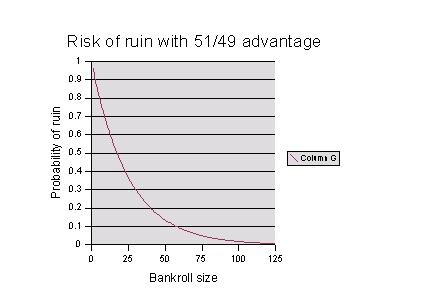
So on this graph our bankroll would be 1000, and our risk or ruin <<<<<<<<1%. There's all the equations there of how it's worked out too if you want the exact number. |
are correct |
|
| Eh, I can go a few more orbits in life, before taxes blind me out - PoorUser | |
|
| 1 | |
| | On September 10 2008 23:52 Catul wrote:
Show nested quote +
On September 10 2008 20:43 CrownRoyal wrote:
lol why the fuck are you guys trying to do math |
Because you're wrong and we're right :D
I can post a proof, but I'll try to convince you intuitively first.
First of all, the probability has to be stricly > 0. If you lose the 1000 first flips (which will happen with probability .49^1000, which is > 0), you're busto. So it can happen and the solution can't be exactly 0%.
Overall you'll be winning money and your bankroll will be growing. The more it grows, the less the chance you can go busto. As the time goes to infinity, so does your expected bankroll. The probability it can reach 0 goes down exponentially with the size of your bankroll.
|
it's so clear to me now |
|
| 1
 |
zodion Germany. Sep 11 2008 08:21. Posts 260 | | |
probability < infinity
you have to play until you bust, so you will bust, % dont matter as long as they are not 0, or 100%.
Taking large sample sizes to proof a point doesnt make sense because you never get close to infinity.
Even if your a 99 % favorite every time you still will go broke vs. infinity |
|
| 1
 |
lachlan Australia. Sep 11 2008 08:25. Posts 6991 | | |
| | On September 11 2008 07:21 zodion wrote:
probability < infinity
you have to play until you bust, so you will bust, % dont matter as long as they are not 0, or 100%.
Taking large sample sizes to proof a point doesnt make sense because you never get close to infinity.
Even if your a 99 % favorite every time you still will go broke vs. infinity |
i cant believe this. i know what u are saying but i dont think just cos it goes for infinity, means u will always bust |
| |
|
| 1
 |
GsOne Poland. Sep 11 2008 08:33. Posts 732 | | |
| | On September 10 2008 23:52 Catul wrote:
Show nested quote +
On September 10 2008 20:43 CrownRoyal wrote:
lol why the fuck are you guys trying to do math |
Because you're wrong and we're right :D
I can post a proof, but I'll try to convince you intuitively first.
First of all, the probability has to be stricly > 0. If you lose the 1000 first flips (which will happen with probability .49^1000, which is > 0), you're busto. So it can happen and the solution can't be exactly 0%.
Overall you'll be winning money and your bankroll will be growing. The more it grows, the less the chance you can go busto. As the time goes to infinity, so does your expected bankroll. The probability it can reach 0 goes down exponentially with the size of your bankroll.
|
Well, this analysis has so many holes it's not even worth mentioning them all (just one - you can go busto in more then one way with more than 1000 flips), and you're pulling numbers out of your ass. It's more complicated than this.
The random walk is a great idea, however fact that we stop playing when we go busto makes this bit complicated, as it affects all states probabilities, except for most optimistic 1000, for sample sizes greater than starting br, and probability of going busto may start growing, with no visible limit (I'm not even sure IF it's growing, or just going down slower) |
|
| THE RAKE - Hair Styling Tips by Daniel Negreanu | Last edit: 11/09/2008 08:36 |
|
| 0
 |
Sheitan Canada. Sep 11 2008 08:34. Posts 4217 | | |
But you know that actually the house has an edge on you at blackjack and not the opposite right ? Unless you count cards and they only use 1 deck. |
|
| Odds are exactly 50%, either happens or it doesnt | |
|
| 1
 |
CrownRoyal United States. Sep 11 2008 10:59. Posts 11386 | | |
sheitan ive seen 21 the movie and rainman and you're wrong they won lots of monies |
| |
|
| 1
|
CrownRoyal United States. Sep 11 2008 11:00. Posts 11386 | | |
catul why do we have to lose consecutively? 1000 times wtf? there are so many other ways to lose |
| |
|
| 2
 |
Catul France. Sep 11 2008 12:03. Posts 1460 | | |
| | On September 11 2008 07:33 GsOne wrote:
Show nested quote +
On September 10 2008 23:52 Catul wrote:
| | On September 10 2008 20:43 CrownRoyal wrote:
lol why the fuck are you guys trying to do math |
Because you're wrong and we're right :D
I can post a proof, but I'll try to convince you intuitively first.
First of all, the probability has to be stricly > 0. If you lose the 1000 first flips (which will happen with probability .49^1000, which is > 0), you're busto. So it can happen and the solution can't be exactly 0%.
Overall you'll be winning money and your bankroll will be growing. The more it grows, the less the chance you can go busto. As the time goes to infinity, so does your expected bankroll. The probability it can reach 0 goes down exponentially with the size of your bankroll.
|
Well, this analysis has so many holes it's not even worth mentioning them all (just one - you can go busto in more then one way with more than 1000 flips), and you're pulling numbers out of your ass. It's more complicated than this.
The random walk is a great idea, however fact that we stop playing when we go busto makes this bit complicated, as it affects all states probabilities, except for most optimistic 1000, for sample sizes greater than starting br, and probability of going busto may start growing, with no visible limit (I'm not even sure IF it's growing, or just going down slower) |
lol wtf I'm trying to dumb it down and even saying I'm doing so and you're telling me this has many holes and that it's more complicated than this ?
| | you can go busto in more then one way with more than 1000 flips |
Irrelevant, reread my post. What I said about losing the first 1000 flips only proves you have a > 0 chance to go bust since I showed one possibility.
I don't know where in my message I'm pulling numbers out of my ass. My answer above ( (49/51)^1000 ) is the exact answer, and I'd have bothered to write a proof if killThemDonks and Oly hadn't already provided links to it. The random walk isn't a "great idea", it's the fucking solution.
Now that I've read the links they gave, there is no complete proof (although it's strongly hinted at in the wikipedia article), so here's one. I've put it in spoiler because it takes quite some place. It's nothing difficult though and I've detailed every step.
+ Show Spoiler +
You start with a bankroll $x.
You play until your capital reaches N or 0 (those would be absorbing states in Markov chains lingo). We'll solve for the infinity case later.
Each time you play, you have a probability p of winning $1 and a probabilty q of losing $1, with q=1-p.
Let  be the probability that you go busto before reaching N given you start with $k. We're looking to find the general form of 
We have  and  .
If your roll is at $k and you play once, with probability p you're going to be at $k+1 and with probability q at $k-1. In the first case, the probability of eventually busting is  and in the second case  . We can write :
 , for  .
We can rewrite this as :
 p_k = p p_{k+1} + q p_{k-1}) (because p+q=1)
 = q(p_k-p_{k-1}))
 = \frac{q}{p}(p_k-p_{k-1}))
By replacing the right term using the same equation until you reach  it is easy to see that gives
 = (\frac{q}{p})^k (p_1-p_0))
Now we're going to sum the left term for all k from N to 0 :
 = (p_N-p_{N-1}) + (p_{N-1}-p_{N-2}) + \ldots + (p_2-p_1) + (p_1-p_0) = p_N - p_0 = -1)
 = \sum_{k=0}^{N-1} (\frac{q}{p})^k (p_1-p_0) = (p_1-p_0) \sum_{k=0}^{N-1} (\frac{q}{p})^k = -1)
For the special case p=q=1/2 this gives
 N = -1)
For p not equal to q, we get
 \frac{(\frac{q}{p})^N-1}{(\frac{q}{p})-1} = -1) (the barely readable thing in ( ) is q/p)
 = -\frac{(\frac{q}{p})-1}{(\frac{q}{p})^N-1})
 = \sum_{k=0}^{x-1} (p_{k+1}-p_k) = (p_1-p_0) \sum_{k=0}^{x-1} (\frac{q}{p})^k = (p_1-p_0) \frac{(\frac{q}{p})-1}{(\frac{q}{p})^x-1})
Replacing with what we obtained for p1-p0 above :
 = -\frac{(\frac{q}{p})-1}{(\frac{q}{p})^N-1} \frac{(\frac{q}{p})-1}{(\frac{q}{p})^x-1} = -\frac{(\frac{q}{p})^x-1}{(\frac{q}{p})^N-1}) And finally
And finally
^x-1}{(\frac{q}{p})^N-1})
For p=q, it's very easy to find the same way

Now, if we look at the probability  of reaching N before going busto, we can do it the same, but going towards  instead of and we find
^x-1}{(\frac{q}{p})^N-1})
and for p = q = 1/2

Note that it was not (completely) obvious that  . As it is the case, we have proven the game ends with probability 1 (we reach either N or 0 at some point or another).
Now, back to our original problem. We play against the house who has infinite money. We find the probability of busting by letting N go to infinity in our expression above. 3 cases appear :
1. q > p : that means we have more chance to lose a flip than win a flip

When the house has an edge and infinity money, we busto with probability 1 (no kidding).
2. q = p : we're flipping 50/50
Even when the house has no edge, as long as it has infininte money and we don't have an edge either, we busto with probability 1 (no shock either).
3. q < p : we have an edge
^x-1}{-1} = 1+(\frac{q}{p})^x-1 = (\frac{q}{p})^x)
There we go. This defines the probability that was asked in the original post :
^x)
where
 is the probability of busting starting with a bankroll of $x and playing for $1 everytime is the probability of busting starting with a bankroll of $x and playing for $1 everytime
 is the probability of winning each time is the probability of winning each time
 is the probability of losing each time (p+q=1) is the probability of losing each time (p+q=1)
|
|
| Sometimes nothing can be a real cool hand. | Last edit: 11/09/2008 12:09 |
|
| 2
|
Catul France. Sep 11 2008 12:05. Posts 1460 | | |
| | On September 11 2008 10:00 CrownRoyal wrote:
catul why do we have to lose consecutively? 1000 times wtf? there are so many other ways to lose |
Doesn't anybody read what I write or something ?
I said we could lose 1000 times in a row to prove that we have at least some chance of busting. It can't be 0.
|
|
| Sometimes nothing can be a real cool hand. | Last edit: 11/09/2008 12:08 |
|
| 0
|
eightfourO United States. Sep 11 2008 12:06. Posts 820 | | |
wtf is that. i don't even want to quote it. or read it. |
|
| I am a god damn Rootin Tootin Shootin Cowboy!! | Last edit: 11/09/2008 12:06 |
|
| 1
|
Yugless United States. Sep 11 2008 12:08. Posts 7174 | | |
holy crap Catul i have no idea what any of that means but i believe you |
|
| Baal - look is talking hah. | Last edit: 11/09/2008 12:09 |
|
| 2
|
Catul France. Sep 11 2008 12:09. Posts 1460 | | |
I put it in spoiler now, it was taking way too much space. |
|
| Sometimes nothing can be a real cool hand. | |
|
| 1
|
CrownRoyal United States. Sep 11 2008 12:14. Posts 11386 | | |
| | On September 11 2008 11:05 Catul wrote:
Show nested quote +
On September 11 2008 10:00 CrownRoyal wrote:
catul why do we have to lose consecutively? 1000 times wtf? there are so many other ways to lose |
Doesn't anybody read what I write or something ?
I said we could lose 1000 times in a row to prove that we have at least some chance of busting. It can't be 0.
|
oh wtf i thought you was disagreeing with me and saying that we could never go busto |
| |
|
| 1
|
CrownRoyal United States. Sep 11 2008 12:15. Posts 11386 | | |
and your proof is so ridiculous i don't have any ambition to look at it or understand it sorry. |
| |
|
| 1
|
CrownRoyal United States. Sep 11 2008 12:17. Posts 11386 | | |
seriously where do you learn to write walls of math problems like that, im pretty sure if you was just bullshitting that no one would call your bluff its so impressive |
| |
|
| 4
|
[vital]Myth United States. Sep 11 2008 12:28. Posts 12159 | | |
anyone who disagrees with this extremely basic markov chain solution put forth by catul has just never received the proper mathematical education to even understand the original problem anyway.
there's a good reason we don't hire people like [insert whoever still thinks you're 100% to go busto] to teach courses in higher math. |
|
| Eh, I can go a few more orbits in life, before taxes blind me out - PoorUser | |
|
| 1 | |
i immagine the number has to be very close 0 since we have positive expectation on every investment of 20 cents for every $10, obviously as N (N being number of intervals) approaches infinity so will our bankroll as craytoul described |
|
| Our deepest fear is not that we are inadequate. Our deepest fear is that we are powerful beyond measure. It is our light not our darkness that most frightens us and as we let our own lights shine we unconsciously give other people permision to do the same | |
|
| |
|
|
 Poker Streams | |
|



 Contact Users: 760 Active, 0 Logged in - Time: 23:59


 ,
,
 ,
,
 ,
,


 ,
,